Tuesday, February 16, 2010

Good Times are Rolling for NOLA

Super Bowl win…City coming back to life…To celebrate Mardi Gras, here’s a version of my New Orleans article that appeared in the latest issue of VERTICAL, Tampa Bay’s beautiful new online style magazine!

Go to http://www.verticaltampabay.com/ to see more of this gorgeous publication!

I like to get lost in the past.

Maybe that’s why I’m drawn to New Orleans time and again. Shacked up for a long weekend in the French Quarter, I can leave the 21st century behind. Its architecture—ramshackle plaster, ancient bricks, mysterious courtyards—works as well as any time machine.

Many of the hotels, although modern inside, are built around old bones that have existed for over a century. A favorite haunt is the Dauphine Orleans Hotel, a former 18th century townhouse and its adjoining bar, May Baily’s Place (once a well-known Storyville bordello).

Dining in the past is easy too—no shortage of joints doing what they’ve done best for decades.

• Café du Monde: frying perfect beignets and perking chicory coffee since 1862 (don’t wear the chic black turtleneck—it’s not so chic with a snowdrift of powdered sugar across your chest.)
(http://www.cafedumonde.com/)

• Central Grocery: est. 1906; this Italian market’s prized invention: the muffaletta—a whopping sandwich smothered in olive salad, ham, salami and cheeses.

• Fiorella’s: It’s been around since 1937 and I’d love to sample some of their Italian specialties but I can’t get past the spicy fried chicken.

Drink up—the Quarter abounds with bars and cocktails that go way back.

• Napoleon House, ca. 1914: Sipping a Pimm’s Cup in a dark corner booth is a great antidote to the hot Southern sun.

• The Roosevelt Hotel bar’s Ramos Gin Fizz (trademarked in 1935)

• The Swizzle Stick Bar inside Loew’s Hotel, where, if you ask nicely, their top notch bartender will mix an Aviation—a lavender-hued marvel that first landed around 1916. (http://www.cafeadelaide.com/)

Some fab new attractions steeped in history that couldn’t have a more appropriate home base than New Orleans:

• The Southern Food and Beverage Museum (SoFAB) fosters a newfound appreciation for that oyster po’boy.

• The Museum of the American Cocktail (part of SoFAB) highlights the evolution of mixology with well-preserved artifacts. (http://www.museumoftheamericancocktail.org/)

• Bustout Burlesque at the House of Blues: Glittery, bawdy fun in the best tradition of Bourbon Street’s famous 1950s nightclubs before they went to seed (see photo above). (www.bustoutburlesque.com/)

New Orleans’ trademark joie de vivre took a big hit in the aftermath of Hurricane Katrina. We can help with its continuing recovery by visiting and supporting the culture that gives us so much—music, art, cuisine, history—and teaches us how to let the good times roll, even when the times get tough.

Wednesday, February 3, 2010

Winging It (or Not)

There was a wrinkle in the time-space continuum when we checked in at the Lord Amherst Motel. The colonial décor conjured up the bicentennial. The bathroom even had a throwback to earlier days: a slot built into the ceramic wall tile for dropping in used razor blades!

We thought we should have some Buffalo wings to commemorate our trip. The Anchor Bar—where, reportedly, someone first fried up wings and smothered them in hot sauce—was in the opposite direction, back downtown. It was drizzly out and I was starting to sniffle. A former Buffalonian in Florida recommended Duff’s, which happened to be about five minutes away from the motel.

Duff’s was packed but we seemed determined, so we went in and put our names on the list. It’s a divey little place that opened in 1946, and they’ve been “wingin’ it” since 1969.

Duff’s is so popular, people park anywhere (including in front of the neighboring businesses) in order to eat there! In fact, when we walked in, there was a hand-written note on the front door asking patrons to PLEASE not park in the Falafel Bar’s parking lot. Falafel Bar?

David happens to love falafels. It’s a Middle Eastern dish—balls of chickpea flour and spices, fried and served in a pita with lettuce, tomato, and usually a sauce like the Greek tzaziki, made with yogurt and cucumber. But we were here for the BUFFALO WINGS! Right?

After a few more minutes waiting in the increasingly busy, noisy vestibule, we both admitted that we really weren’t that keen on chicken wings (they’re SO messy anyway!) and what we’d really like to try was…You guessed it, The Falafel Bar, two doors down.

We had an amazing meal of falafels, grilled chicken and potatoes, Greek salads, lentil soup, hot tea—we were stuffed and happy. And we didn’t miss the wings at all.

Friday, January 22, 2010

Buffalo Roundabout

The visitors’ center at the Darwin Martin Complex is one of the most lovely and intriguing I’ve ever seen. The modernist glass box doesn’t compete with the blocky residence yet it’s a design marvel in its own right.

We really loved the giant plasma touch screens hanging on one recessed wall. These techno marvels share information not only about the house, its architect and its inhabitants, but also the built environment of Buffalo itself, with interactive maps showcasing some of the highlights. The orientation video was projected onto a transparent glass wall in front of a row of benches. Trés cool.

The Darwin Martin House is said to be to be Wright’s finest example of his Prairie-style architecture. The family’s fortunes took a hit during the Great Depression and Darwin died in 1935, leaving his wife Isabelle saddled with debt. She closed up the house—she never really liked it—and retreated to the family’s summer estate (also designed by Wright) on the Lake Erie shore.

The city took ownership over unpaid taxes and it had several other uses until falling into disrepair, as great houses sometimes do, until it was rescued by a Wright-loving foundation that is raising money and restoring it to its former glory. Unfortunately, much of the house was off limits to regular tour guests because it’s in various stages of restoration, but we got to see the first floor and the reconstructed stable that is now the gift shop. The Gardener’s Cottage (below) represents an affordable and utilitarian residence designed for the working class man.

People seem to either love or hate Frank Lloyd Wright. His tumultuous, scandal-ridden life is really quite fascinating. I think in some cases, you can’t have that much genius without some accompanying madness.

I like his architecture—the geometric shapes are pleasing to the eye; the way they work within the landscape, and the scale and design are comforting. And it’s not all just straight lines and flat planes. He leaves plenty of room for finely crafted detail.

You can read more about Darwin Martin and the house that Frank built here: http://darwinmartinhouse.org/.

UP NEXT: Winging It (Or Not)

Tuesday, November 10, 2009

Buffalo Bound

After a while, I stopped telling people we were going to Buffalo and switched to Niagara Falls (another destination on our itinerary). That seemed to make it go down a little easier.

Why? Well, as you may know, Buffalo’s got a bit of a reputation for being a not-very-nice place—a city in decline, terrible winters…

But really—what place doesn’t have its list of negatives, which we all know are more entertaining to bitch about than the positives?

Conversely, there’s a self-satisfying pleasure in seeking out the good stuff—kind of like a cosmic treasure hunt that makes you feel a bit more connected to the beauty of the world and less affected by the ugliness.

We began and ended our recent trip to Western New York in the Buffalo area and I’ve got to say—our experience was pretty flawless. (Of course, my observations have also shown me that a lot has to do with the traveler’s attitude to begin with but that’s another story…)

Checking in, passing through security, and boarding our Southwest flight was a breeze—Tampa International is a great airport.

Likewise, the Buffalo airport was as easy to navigate as my friend and former Buffalo-gal-by-way-of-Williamsville, Carla, promised it would be. In one smooth twirl, we deplaned, swooped up our suitcases, and parked ourselves at the rental car counter just across from the baggage claim. Ten minutes later, we were hurtling down the interstate headed for our first destination…Frank Lloyd Wright’s Darwin Martin Complex.

Up next…Buffalo Roundabout

Tuesday, September 22, 2009

NOLA's Slow Rebirth

The city’s still hurting.

It may be business as usual with crowds filling the French Quarter again but the joie de vive is definitely feeling a quart low. New Orleans seems just as mired in its economic, educational and political morass as ever, magnified by the poignant losses exposed in the aftermath of Hurricane Katrina, like pulling a band-aid off a nasty scab that was nowhere near being healed to begin with. Now the nation and the world have witnessed the grim, gritty, muck-infested reality of the people who live there.

The political corruption and socioeconomic quagmires stretch back across so many decades, better days will be a long time coming—IF the parties involved can make the kind of commitment necessary to bring about healthy change.

But there’s got to be something the rest of us can do. And there is.

Visit New Orleans. Support the culture that gives our nation so many unique gifts—in music, art, cuisine, history—and teaches us how to let the good times roll, even when the times get tough.

During a recent trip to New Orleans in the heat of summer, I was surprised and pleased to see the French Quarter teeming with life: families piling into the Audubon Aquarium, restaurants with interminable waits, new museums sprouting up here and there.

The Southern Food and Beverage Museum has taken up residence at one end of Riverwalk, the bland and touristy—albeit blissfully air conditioned—strip mall that parallels the Mississippi and cozies up to the convention center. Inside, visitors stroll through exhibits showcasing the delicacies of the region, giving greater understanding the next time one sits down in front of an oyster po’boy, a bowl of corn grits and other iconic foods of the South.

SoFAB is also home to the Museum of the American Cocktail—an outstanding collection of everything liquor-related spanning the centuries. Gorgeous displays highlight the evolution of mixology with well-preserved artifacts: bottles, glasses, shakers and other paraphernalia like recipe booklets, aprons and even the appropriate LPs to spin, creating the proper aural ambience for martini imbibing.

Halfway down Royal Street, past the tony antique emporiums, a Creole cottage-turned-storefront sports a shop dedicated to the Green Fairy, which as been making a resurgence of late. Nasty stuff, absinthe, but it conjures the romantic bohemian days of turn-of-the-last-century Paris. At the back of the little boutique, an intimate “museum” of sorts awaits, ready to share the history of the liqueur through artifact displays and a looping documentary.

There are new things to see along with old favorites, there’s still good food to be eaten, and May Baily’s still mixes the best Hurricane in town.

So go.

Sunday, September 13, 2009

Mt. Dora Exploras

A recent day trip with friends took us to this central Florida hamlet known for its antiques shops. If hardcore antiquing is what you’re after, here’s a hint: skip the old lady boutiques in town and head for Renninger’s on U.S. 441 for a real avalanche of the stuff.

Seriously, the downtown stores are nice—if you’re shopping for your granny or your bridesmaids: a lot of frilly, girly stuff and tacky gifts no one really needs, with miscellaneous knick knacks scattered in between. (The smarter shopkeepers plant Man Benches outside their doors for gravity-weary companions.) To be fair, I did find a couple of interesting boutiques and a good cupcake shop, but it wasn't enough to make me want to go back.

For lunch: The Goblin Market scored points for the mysterious, secluded entry into a viny, hidden courtyard. We might have been sneaking into the Goblin’s own library, all book-lined walls and dimly-lit exotic décor. Then the stuffiness set in. They need to throw open the windows once in a while. Stale air quality makes me feel like I'm dining in a place that's perhaps past its prime. (i.e: Gypsy Cab Co. in St. Augustine.)

I might have liked the food more if the whole experience rated a little higher. Everything took FOREVER, from ordering to getting the check, with nary a hint of apology from the lackadaisical crew. We were all starving by the time our salads and sandwiches arrived, at that point when just about anything tastes good.

I’m almost wishing we’d tried the intriguing Icelandic pub with its crazy beer-liquor mixed drinks or the seafood house with the gorgeous veranda view of the lake.

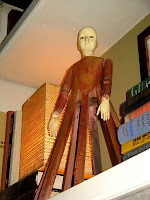
(By the way—theme of the day: scary dolls. We just started seeing a trend.)

After lunch, we headed to the mother of all antiques emporiums, Renninger’s. Set on acres of tree-dotted hillocks, it’s an indoor/outdoor wonderland featuring every make, model and era of vintage paraphernalia that one could hope for. In one corner, a path winds through a makeshift “village” of freestanding shops.

Then there’s the massive warehouse of vendor booths showcasing everything from miscellaneous ephemera to mission furniture. Even if you’re not in buying mode, it’s a treat to chat with the knowledgeable dealers and learn about their various wares.

Renninger’s aside, the next time I’m in the mood to explore a quaint central Florida town, I’ll probably head for Winter Park.

UP NEXT: What’s New in NOLA

Tuesday, August 4, 2009

Cassadaga Nights

“It’s like something out of a Clint Eastwood movie,” said the biker chick to her companions at the table behind ours, describing Cassadaga, the central Florida town we’d just checked out of earlier that morning. Our search for breakfast ended up at Gram’s Kitchen, a Deland diner popular with the chrome and handlebar crowd.

I imagined ol’ Clint squinting in the high noon, attired in a flowing tunic, smelling of nag champa, crystals dangling around his neck, trying to decide where to have his fortune read. Cassadaga’s a one-intersection ghost town in the middle of nowhere dotted with old cracker houses in various stages of repair, sporting shingles for their resident psychics and related service providers.

Long ago, during a séance, New Yorker George Colby was
told that he would establish a spiritualist camp somewhere down south. His spirit guide led him to this “amazing energy vortex” and he founded Cassadaga in 1894. One hundred fifteen years later, Jennie from the Block, Maleficent Mel and I arrived at the Cassadaga Hotel and checked into our room, a tiny little sweatbox at the end of a spooky hallway. A scary-looking wardrobe easily could have been a portal to the Netherworld.

Yes—I blew some hard-earned cash having my tarot cards read—I’m a sucker to discover what infinite possibilities might be wrapped up in the mysteries of the Universe (and a couple of things actually have happened, as predicted).

Communing with the psychic world worked up an appetite, so we headed for the shady grove of DeLeon Springs nearby. At the park’s Old Sugar Mill restaurant, we stuffed ourselves with pancakes made on our tabletop griddle. The icy spring itself was overrun with humanity cooling off in the hot midday sun, so we trundled back to Cassadaga and took a stroll around town.

Its few shops hawk all manner of metaphysical books, crystals and other paraphernalia; the one restaurant, located in our hotel, closes early. Unless you make your own fun, there is seriously nothing to do in Cassadaga, once you’ve exhausted your budget ferreting out mystical guidance from one of their mediums.

The liquid spirits appeared after our nap. We drained a bottle of sweet tea vodka and enjoyed an antipasto spread in our room as the sun went down. Then, cameras at the ready, we set off in search of the spirits Cassadaga is known for.

Our anticipated ghostly apparitions, like anyone else with an ounce of sense, must’ve headed to cooler climes in the midst of the summer heat—substantial photographic orbs were hard to come by, though we did see a few oddities and felt the requisite flash of cooler air in one particularly charged intersection near the lake.

Jennie from the Block launched into an impromptu frolic along the darkened shore as if she’d been possessed by the spirit of a long-ago picnic reveler—and a hirsute one at that, according to the shots Mel snapped. That was the freakiest, most unexplainable event that happened during our expedition.

Back at the hotel, we drifted off to sleep, window unit cranking, with nary a bump in the night.

UP NEXT: Scaling Mt. Dora